
Germany’s Electronic Securities Act (
eWpG
) is revolutionizing the financial sector by enabling fully digital securities
,
often on blockchain-based infrastructure. Since its implementation in 2021, this groundbreaking legislation has accelerated how financial institutions handle securities issuance, trading, and management. While other European countries dematerialized securities years ago, the
eWpG
finally sets a robust legal foundation in Germany for electronic and crypto-based securities. This guide provides a deep dive into the crucial details, from the historical timeline and core definitions to key challenges, benefits, and real-world use cases.
Why eWpG Matters Today
With the growing need for efficient securities transactions and the rapid adoption of digital assets, the
eWpG
is more relevant than ever. It addresses the limitations of traditional securities processe
s,
where physical certificates and multiple intermediaries slow down the system
and aligns with the global shift toward leveraging blockchain technology and distributed ledgers. By offering a legal framework that accommodates electronic and “crypto” securities, Germany aims to
maintain
and strengthen its position as a leading financial center.
eWpG at a Glance
From Physical Certificates to Tokenized Securities
Historically, German law required physical certificates (often in the form of global notes) to
represent
securities. These paper-based instruments were typically “immobilized” within central securities depositories, involving multiple intermediaries. As the digital financial economy expanded, this system became cumbersome and costly.
TL;DR.
eWpG
(Gesetz über elektronische Wertpapiere):
-
Officially in force since
-
Eliminates the strict requirement for a physical certificate
-
Allows digital (dematerialized) issuance and transfer of securities
-
Accommodates
electronic central register securities
(Zentralregisterwertpapiere) and
crypto securities
(Kryptowertpapiere)
Is Germany not the first country...
While Germany only introduced this act in 2021, other European jurisdictions had already moved toward dematerialized securities:
-
France (1984): Fully dematerialized securities, though still reliant on a central depository
-
United Kingdom (1996): Established CREST, an electronic database for securities
-
Switzerland (2009): Legally recognized electronic “Bucheffekte”
-
Luxembourg (2019): Passed blockchain legislation to support digital securities
Despite being late, Germany’s eWpG is comprehensive and aims to place Germany at the forefront of blockchain-powered finance.
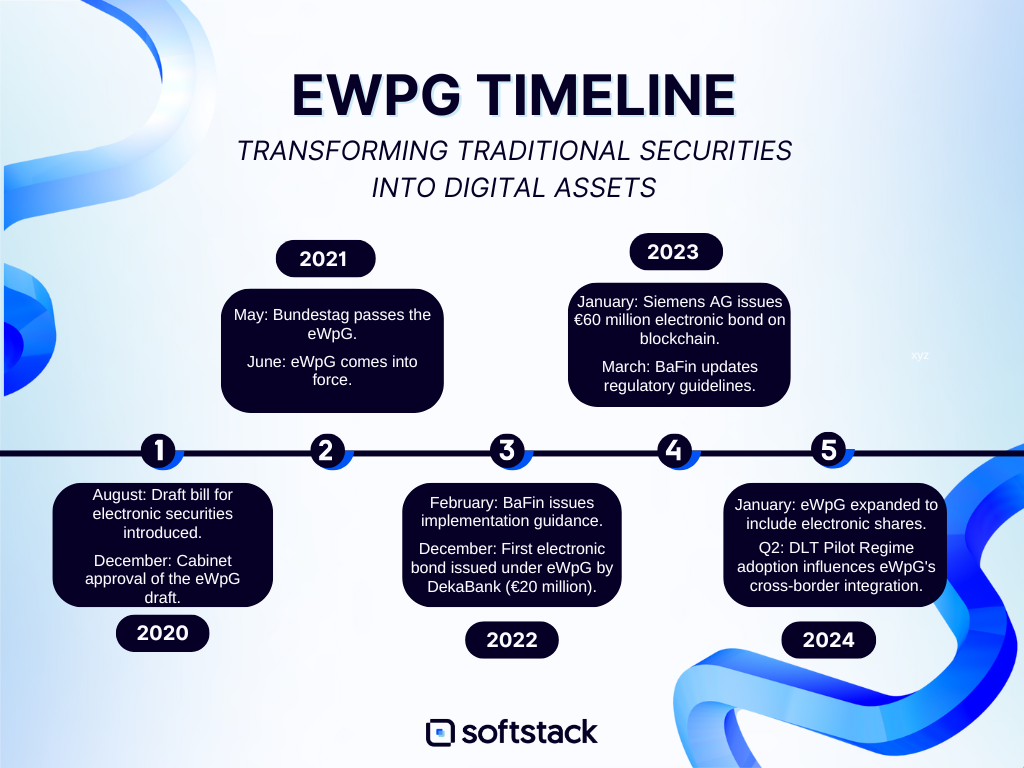
Historical Timeline of the eWpG
To better understand how the eWpG has evolved, here’s a timeline of key milestones since its inception:
Key Definitions Under the eWpG
Because the
eWpG
spans multiple forms of digital securities, clarity in terminology is crucial.
1. Electronic Central Register Securities (Zentralregisterwertpapiere)
Under
§4 Abs. 2 eWpG
, these are electronic securities that replace physical certificates but operate via a central register. This category includes:
- Securities held by a
central securities depository
(Zentralverwahrer)
- Securities held in custody by a
depositary bank
- Individual (Einzel-) registered securities
Although technology-neutral, these registers often rely on modern DLT infrastructures for efficiency. However, they remain distinct from purely blockchain-based “crypto securities.”
2. Crypto Securities (Kryptowertpapiere)
Defined in
§4 Abs. 3 eWpG
, crypto securities are a specific subcategory of electronic securities entered into a
Kryptowertpapierregister
—a register that must be:
-
Tamper-resistant
-
Chronologically logging data
-
Protected against unauthorized deletion or modification
Unlike earlier “security tokens” issued without a formal legal framework, these crypto securities are now fully regulated
, requiring public notification in the Federal Gazette and oversight by BaFin. They enjoy the same legal status as paper-based instruments via a statutory fiction that treats them as “Sachen” (things) under German property law.
3. Central Electronic Securities Register (Elektronisches Zentralregister)
Per
§12ff.
eWpG
, this register is typically
operated
by a
licensed central securities depository
(
Zentralverwahrer
). While the law is technology-agnostic, in practice, it often integrates blockchain or similar distributed ledger technologies.
4. Crypto Securities Register (Kryptowertpapierregister)
Also technology-neutral but strongly oriented toward distributed ledger solutions, the
Kryptowertpapierregister
can be maintained by any entity with the appropriate license and BaFin oversight (e.g., specialized fintechs, technology providers, or the issuer itself). Key requirements include:
-
Recording the essential contents of the securities rights
-
Documenting any encumbrances or third-party rights
-
Assigning each security a clear, unalterable identity (e.g., via a Wertpapierkennnummer)
Challenges Facing eWpG Implementation
Implementing eWpG-compliant solutions brings several challenges. On the technical front, organizations may need to invest in IT upgrades, train staff, and update legacy systems to accommodate blockchain or other distributed ledger technologies. Interoperability also poses a hurdle, as differing technology standards can limit seamless communication across platforms. At the same time, compliance demands remain high, with BaFin guidelines requiring secure, transparent record-keeping.
Regulatory uncertainty adds another layer of complexity. While the eWpG is in effect, its scope may expand as the regulatory framework evolves. Market participants need to keep a close eye on potential amendments, new BaFin directives on crypto registers, and any EU-wide changes stemming from the DLT Pilot Regime or other legislation. Maintaining open lines of communication with regulators is critical for staying agile and compliant over the long term.
User adoption and market acceptance can also be slow. Traditional financial institutions—such as investment banks or stock exchanges—may be hesitant to disrupt well-established processes. Building trust in blockchain-based registries, educating investors and issuers on tokenized securities, and overcoming ingrained habits are all essential to driving broader acceptance.
Lastly, awareness and education play a crucial role in the eWpG’s success. BaFin regularly issues guidelines on electronic securities registers, and partnerships with industry associations, like the German Banking Industry Committee, help align best practices. Government initiatives, such as the Federal Ministry for Economic Affairs and Climate Action’s blockchain strategy, further support research and training, while academic centers like the Frankfurt School Blockchain Center run specialized workshops and certification courses for professionals.
Step-by-Step: Issuing Electronic Securities Under the eWpG
The eWpG clarifies the issuance process in four key steps, mirroring the traditional approach but without paper certificates.
- Agreement
The issuer and the investor (or initial subscriber) conclude a contractual agreement specifying the terms of the security—essentially, all legal and financial obligations.
- Begebungsvertrag (Issuance Agreement)
The parties agree that
no physical certificate
will be issued. Instead, the security will be created by entry in a specified electronic register (central or crypto register).
- Emission (Entry in the Register)
The register operator (e.g., a licensed central securities depository, a bank, or a BaFin-approved fintech) records the new securities in either a
Zentralregisterwertpapier
ledger or a
Kryptowertpapierregister
.
- Legal Effect
From the moment of entry, the security is deemed legally valid and treated like a physical certificate under German property law (via the statutory fiction of “Sachen”). It can now be traded, transferred, and held with all the rights and protections of a traditional paper-based security.
Conclusion
The Electronic Securities Act (
eWpG
)
represents
Germany’s decisive move into a new era of finance—one that embraces blockchain and dematerialized securities. While the nation joined the trend later than some neighbors, its holistic legal framework ensures robust investor protection, regulatory clarity, and technological flexibility.
Despite challenges in user adoption, technical integration, and regulatory updates, the
eWpG
stands as a blueprint for modernizing securities markets. As more companies and investors realize the benefits of digital issuance,
Germany’s vision of a fully tokenized capital market
edges closer to reality.
On the technical side,
Softstack
can provide invaluable support in adapting to the new
eWpG
environment. With
expertise
in smart contract software development and smart contract auditing,
Softstack
helps businesses design, deploy, and
maintain
compliant, secure blockchain solutions.
Whether you need end-to-end system development or specialized auditing to ensure robust regulatory alignment,
Softstack’s
services can streamline your transition into Germany’s evolving digital securities landscape.
Further Reading and Resources
- BaFin (Federal Financial Supervisory Authority)
BaFin Homepage
- German Banking Industry Committee (Deutsche Kreditwirtschaft, DK)
Overview via the Association of German Banks
- Federal Ministry for Economic Affairs and Climate Action (BMWK)
BMWK Blockchain Strategy
- Frankfurt School Blockchain Center
Frankfurt School Blockchain Center
- KfW Digital Bond Press Release
KfW Website
- Siemens AG Blockchain Bond Announcement
Siemens AG Newsroom
- DekaBank Corporate Bond News
DekaBank Website


